Things seem really dark this year. I realized that this week as I have been thinking about “Good’” Friday” and “Holy Saturday”. Don’t even get me started on my frustration with it being called “Good” Friday. In Christian tradition, the Friday and Saturday between Maundy Thursday and Easter Sunday are days of darkness and grief as we mourn the death of Jesus. I admirably respect the traditions that acknowledge the death as much as the resurrection. In order for there to be a resurrection, there had to be a death. When I took Old Testament during seminary, I had to write a paper on what Holy Saturday would be like for the followers of Jesus, in the Gospels. It was one of my best works. Sadly, I can’t find it. But I wrote about the darkness of the death and how the people navigated between the darkness and the hope. I imagined there was an internal struggle, wondering if Jesus would actually come back. The people walked around in mourning,reviewing the images of the crucifixion that were forever etched in their hearts. While reviewing the images, Jesus’s voice could be overheard, with his promise, a promise he made himself; that hey would return. And just like any other individual in mourning, they wondered if he actually would.
It is Friday, April 7, 2023 and I feel like we are in that darkness. I know I feel that way. I feel like as a country, as a world really; we’ve been going through the darkness for quite some time. As I walk through the hallways of my work, I have seen a lot of darkness. As I think about what I’ve seen in the hospital, there is a lot of darkness and the overcast of clouds are only making it worse.
It’s not Covid this time. It is gun violence. It’s always been gun violence. There has been a steady increase. There has been a rapid increase in violence and what’s worse, the victims and the shooters are getting younger. They are teenagers, some barely out of their tweens. Their bodies look like red stained Swiss cheese and their faces look like children who had no way of knowing how to maneuver through their lives. Their bandages can’t stop the blood seeping from their heads. Their heads are suffering not only from penetrating gun shot wounds but also from a lack of minds that are mature enough to face what they have to face every day.The families are at bedside, crying in the darkness of their grief that they are too scared to acknowledge.
When i leave work for the day, i try hard to keep my promise of not watching the local news. I see the news every day in the hospital, so i don’t need to see it on tv or internet.Sadly, the news from around the country manages to enter my doors that i’ve tried hard to lock. The children i stood next to today were not the only children shot. Gun violence is the number one killer of children in the United States. When I leave work, i know i am not the only trauma chaplain holding the hands of grief stricken families. There are parents in other parts of the state and in other parts of the country, sitting at the bedside of their children. They are thinking about the last thing they did together, the last words they exchanged, the last time they heard their child laugh and wondering if they can afford the child size coffin they are too afraid to consider.
It’s incredibly dark right now and I am walking around in a bit of a haze. There are images playing in my head about the events i’ve seen on the news from Tennessee, Sandy Hook, and Columbine, just to name a few. The images of children i’ve seen in the hospital are running through my mind, too. I wonder what i will see tomorrow.I am not exactly sure but i am not feeling very hopeful that the promise of a resurrection will come true.
Walking through these halls, you have absolutely no idea Exactly what you will encounter after each corner you turn You know, one split second will turn it all upside down And in a blink of an eye, your perspective will never be the same A different perspective
Over the last few years, many stories have been shared Each chapter played out in unexpected, unscripted dramas If you didn’t know any better, none of this would be true Your experience tells you, that every second is all too real A different perspective
Standing by the trauma bay, you watch it unfold, a story all too common In a matter of seconds, the patient arrives, having been shot multiple times Trauma Attendings on both sides and ED Doctors at the head If they do the impossible, this patient might actually survive Days later, the chaplain sits at bedside, as this miracle talks about his faith A different perspective
Family called and requested prayer as their patriarch with covid, was to be intubated After they talked and prayed together the chaplain held the patient’s hand through his sedation The chaplain called family and shared the visit; with gratitude they cried “how did he look?” That prayer was the last he ever heard and “amen” was the last word he ever said. A different perspective
Making rounds on the units, to check on the staff with intentionality On one side of the unit, the chaplain comforts a nurse through tears After family expressed their emotions in unfortunate, belligerent ways On the other side of the unit, a family embraces a nurse with gratitude As they expressed their appreciation for taking care of one of their own A different perspective
You’re paged to the MICU for a covid patient that is about to pass Due to visitor restrictions, two family members watch from outside of the room The chaplain stands beside them, providing a gentle touch and sacred silence The nurse strokes his forehead and respiratory cradles his hand, as the last breath is taken A different perspective
A driver, with full term pregnancy, arrived, after having been in a car collision ED Team, Trauma Team, OB Team, and one chaplain; 46 people already there This child had seconds to be delivered but mother requested prayer before entry An understanding scalpel paused; a prayer was said and this precious one was finally free A different perspective
When you walk around, you’ll measure this and quantify that Take a moment to see what is happening around you It’s always good to look at things from a different point of view In a matter of seconds, your perspective may never be the same A different perspective
When I started in chaplaincy a long time ago, silence was awkward for me. Ironically, I am an extreme introvert and adore silence, when it’s outside of the hospital and in my control. When I am sitting with a patient’s family, who just received bad news, or anticipating bad news, silence can be deafening.
Last week, one of my patients coded and despite heroic efforts, the patient died. The spouse was present and it would be a while before other family arrived. The spouse and I sat in the family conference room while we waited.
I used to want to fix things for the families. I wanted to say something that made a difference for them; that would help them feel better. That’s why the silence was awkward for me. I thought I needed to say something to bring comfort to the family, or to ease the family’s anxiety and distress. If their distress was elevated, I knew what needed to be done to help settle them down. If they were simply in a quiet place, appropriately emotional and concerned, I thought I needed to make the silence go away and do what I could to make things right.
With experience and maturity, I learned that nothing I could say, will fix it. No matter what I said, I could not make them feel better or worry less. In fact, there were times I said “something” and made the situation even worse. Thankfully, I grew in my experience and learned that silence can be a comforting place to sit with someone in their pain and grief.
That’s what happened last week. The spouse said she was “fine’, however it was clear, she was not. She just witnessed the code event of her husband and he didn’t survive. I acknowledged and affirmed her strength and said I would “stick around, just in case”. I can tell when someone DOES wants me to leave and I will respect their wishes but she wasn’t sure what she needed. I did step away a few times, to give her some privacy. That’s important for a family member, especially knowing that the next days ahead, she is not going to have much privacy. When I returned, she didn’t need anything, so I simply stayed in the room. We sat in the comfort of silence and it was quite peaceful.
Clinicians say to me all they time, “Linda, I don’t know what to say or what to do”. I tell them to keep doing what they are trained to do and remember that they don’t have to say anything different, or anything at all. Silence is not a bad thing, especially in someone’s grief. They already know we can’t fix things and we won’t be able to make them feel better. What we can do is remind someone that they are not alone. We simply have to be present, sitting in the silence, together.
When the wife left, she hugged me and expressed her gratitude for the care i provided, saying that it helped. I didn’t do much. I simply sat in the same room with her and let the silence speak for herself.
I have seen it firsthand. It is horrific. It is heartbreaking. It is isolating. It is real. It is a pandemic.
Patients are overflowing the hospitals. Families cannot be at bedside. Teams are short-staffed. Health care workers are burned out. Front line providers are suffering from compassion fatigue.
Covid is real.
Nurses, doctors, and their families have been quarantined because they had covid.
Respiratory departments were almost half-staff because an entire team was hit with the virus.
An environmental service employee cried as she shared about her near death experience with Covid with fear trembling in her voice.
Hundreds of staff members have to be tested after they came in contact with patients who didn’t know they were positive.
Departments have lost colleagues because Covid took them too soon.
Colleagues have lost family members to the darkness of this pandemic.
Covid is real.
When I stood outside a patient’s room, to support her family. They stared into the room, lost in their anger and grief. They not only grieved the death of their mother but also their loss of not being able to touch her, hold her hand, or kiss her goodbye.
Covid is real.
When I talked to his wife on the phone after I visited her husband in the Covid ICU. She asked a question, grasping for any glimpse of hope, “How does he look?” She knew he struggled with his breathing and would require intubation if it didn’t improve. That night he was intubated and never made it home.
Covid is real.
When I held the hand of a nurse and prayed at his bedside. He was on the covid unit, not as a nurse but as a patient. I held his hand as he struggled to breathe. Just like every other nurse, he was caring for others, who were struggling with the same pain. Just like every other nurse, he sacrificed his health to continue to serve in his role. Just like every other nurse, he returned back to work to continue his calling.
Covid is real.
When I received my positive test result on Christmas Eve after being symptomatic. I was quarantined at home, alone, for ten days and stayed home to recover for another seven. I had a mild case and am still dealing with remnants of that impact. Given what I witnessed in the deaths and grief of many, I was blessed with a mild case of this reality.
Given what I witnessed standing with two sons, who stood outside their dad’s room, as their dad took his last breath. I was honored to watch the Respiratory Therapist and the Nurse, held their dad’s hands for comfort and propped up the tablet as his wife talked to him on the video..I was blessed with a mild case of this reality.
Covid is real.
When I returned to work and two days later, sat at a patient’s bedside, holding his hand. He had tested positive for Covid and was mourning the loss of his wife. She died of Covid less than 24 hours ago and he was not able to be there with her.
Covid is real.
And if you think it’s a hoax, a prank, or some conspiracy theory; you are painfully wrong. You and your family may not have been impacted by the Corona virus (thus far) but you have clearly been impacted by something worse……a loss that is beyond my level of understanding.
This is part 1 of 2 posts I will have on faith in healthcare. This first post is from article I submitted and that was originally published in The Community Magazine of the North Carolina Free Will Baptists Foundation.
*****
I was called to a patient’s room one evening. A patient, in the final stages of an incurable cancer, would not answer any of the medical team’s questions. He would not make any decisions about his medical care. For reasons clear and unclear, he was angry and bitter towards the team and family. The medical team recognized the emotional distress the patient was in and as a member of the interdisciplinary team, I was asked to talk with the patient.
The patient believed the cancer was a punishment from God. Not only did he think it was a punishment from God but he believed he deserved the pain and suffering that came with it. The patient had not forgiven himself for moments in his past and he was afraid he would go to hell. So by not making any medical decisions, he kept himself from going to hell and continued to punish himself in suffering.
We talked about suffering, forgiveness and healing. The patient was able to hear about and feel the presence of a loving God who loved this patient as a precious child. This precious child was worthy of forgiveness and a life that may have been filled with pain and suffering, did not have to end that way. He made some important decisions in the next few days and within a week, he died peacefully with family by his side and a heart free of pain and suffering. I have no doubt he was welcomed into Heaven and into the loving arms of Jesus Christ, who understood his suffering better than anyone.
The matriarch of the family had a brain injury. She was unresponsive and relied on a ventilator to breathe. The swelling increased and her body became dependent on medicines and machines to keep her alive. In a meeting with the family, they shared that the patient made her wishes clear a long time ago, when it came to her healthcare and healing. If her body were only alive because of machines and medicines, she wanted her family to free her of the pain and let her go to Heaven. In fact she stated, “Give me three days on the machines and if I don’t rise like Jesus or Lazarus, let me go.”
The team acknowledged and respected the faithful decisions of the patient and family. In the time allowed, the team and family worked together to do all they could for the patient’s care and wellbeing. Three days later, there was still no improvement in the patient. Her family, her children and grandchildren, were taught about faith from this matriarch. They agreed with the patient’s wishes. Aggressive measures were stopped and the ventilator (or mechanical support as I like to call it) was removed. She passed away peacefully and surrounded by family (or her life support as I like to call it). The matriarch became the miracle they prayed for, completely healed in heaven.
I share these two stories because they are two extreme differences in faith. One faith could have made the patient suffer a painful life and an equally painful death if he wasn’t reminded of God’s love and grace. The other faith knew that death was a part of life and that God provided for both, a life on earth and a life in heaven. I share these two stories as examples of how faith can have an impact on healthcare. As patients, families and medical teams journey through the life of healthcare and healing, the role of faith has become an integral part of the holistic plan of care.
Hospitals and physicians have recognized that in caring for the patient it is important to provide holistic care, recognizing that faith and spirituality are important factors in the care of a patient. It is so important that the Joint Commission on Accreditation of Healthcare Organization now requires healthcare organizations to include a spiritual assessment in the care of patients. That requirement can include professional chaplains as members of the healthcare team.
As a board certified hospital chaplain, I see every single day how faith has been an important factor in a patient’s life; and many times, the most important factor. More and more, patients acknowledge that their faith and spirituality are needed coping mechanisms in their wellbeing and in their healing. Their faith has provided them a strong prayer life, using spiritual practices from their faith tradition; practices that bring them comfort, assurance and hope. Their faith reminds them of the need for a strong support system from their family, friends and their faith community. Their faith reminds them that God is there, when they are weary and burdened, in need of healing and rest.
When you are in the hospital, you are in a vulnerable state of being. You are humbled into the confines of a hospital room, where you have to rely on other people to take care of you. You also have to let go of any control that you might have in the uncontrollable. Your faith will allow you to see how God is able to provide in the midst of your vulnerability because you are having to fully rely on God, in ways you never imagined or were prepared for.
That faith can help a patient, as it did with the matriarch I mentioned earlier. Her faith was undeniable. Her faith was in her life, in her teaching, in her work and in the raising of her family. She shared every part of her faith and trust in God with her family. That trust included the fact that God had control of her life and that death is a part of life. Her faith directed her Living Will and her medical decisions. Her life was already led by God and she wanted to put her death in God’s hands, too.
Faith can be incredibly helpful but it can be deeply painful, if misunderstood. In times of trauma, pain, suffering and critical need, faith can bring about emotional and spiritual distress as it did with the story of the first patient. At some point in his life, his faith taught him that God punishes people, God gives cancer, and that people (no matter how human) deserve painful suffering and death, with no forgiveness or grace.
Faith can also be misused. I have seen patients with traumatic injuries and incurable diseases who struggled with the “why” of it all. They would ask me questions, “Did I not pray enough?…Did I not go to church enough?” They wondered if they had a stroke because they didn’t go to church. They wondered if they have this disease because they killed people when they served in the military and this was God’s punishment. I’ve even heard their pastors come to visit and say to the patient or family, “You’ve got to pray harder…You need to have more faith….God needed that precious angel (after the death of a child) and your little girl was the next flower God needed to pick.” Talk about a faith misused.
As a chaplain, I am asked more often than not, “Why did this happen?”. When I am asked “why,” my one and only response will always be, “I don’t know.” I don’t know why things happen. Cancers happen. Traumas happen. Disease happens. What I do know is suffering is not a punishment of any sort. Suffering and death are a part of life, even for the most faithful. For Christians, I remind them that Jesus suffered, not only on the cross but also in Gethsemane. Jesus called out to God in distress and questioned God’s will. In the garden, he cried out, “If it is your will, take this cup from me”. While on the cross, in his most vulnerable moment, he asked, “Why have you forsaken me?” It is through Jesus’s agony we are reminded that we are not alone in our suffering.
Proverbs 3:5-6: Trust in the Lord with all your heart, and do not rely on your own insight. In all your ways acknowledge him, and he will make straight your paths.
Jesus reminds me of Proverbs 3:5-6. We’ve got to trust God, even in the midst of all the unanswerable, we’ve got to trust that God will be with us in the vulnerability. God didn’t give him cancer, but who is providing meals in the middle of the treatments? God didn’t cause the car collision but who is helping with the physical therapy? God didn’t take that little girl but who is holding dad’s hand in the midst of the grief? And as we acknowledge God in all of our ways, whether in joy and happiness or anger and sadness, who is right there, hearing every word, feeling every pain, and holding every tear?
Every day, I am reminded that faith can be a coping tool, a medicine if you will, that can bring comfort in the midst of the vulnerability. I am grateful to work with medical teams and healthcare organizations that recognize the importance of the holistic care of patients and families. I meet patients and families in their Gethsemane every day. It’s incredibly humbling to walk with them on this journey even when we don’t know how it will end. Whether the end of the hospital stay includes seeing a on this earth or one of complete healing in heaven, it will be a beautiful and comforting sight, for the patient and the family.

 Things seem really dark this year. I realized that this week as I have been thinking about “Good’” Friday” and “Holy Saturday”. Don’t even get me started on my frustration with it being called “Good” Friday. In Christian tradition, the Friday and Saturday between Maundy Thursday and Easter Sunday are days of darkness and grief as we mourn the death of Jesus. I admirably respect the traditions that acknowledge the death as much as the resurrection. In order for there to be a resurrection, there had to be a death. When I took Old Testament during seminary, I had to write a paper on what Holy Saturday would be like for the followers of Jesus, in the Gospels. It was one of my best works. Sadly, I can’t find it. But I wrote about the darkness of the death and how the people navigated between the darkness and the hope. I imagined there was an internal struggle, wondering if Jesus would actually come back. The people walked around in mourning, reviewing the images of the crucifixion that were forever etched in their hearts. While reviewing the images, Jesus’s voice could be overheard, with his promise, a promise he made himself; that hey would return. And just like any other individual in mourning, they wondered if he actually would.
 Last week, one of my patients coded and despite heroic efforts, the patient died. The spouse was present and it would be a while before other family arrived. The spouse and I sat in the family conference room while we waited.
 When I stood outside a patient’s room, to support her family. They stared into the room, lost in their anger and grief. They not only grieved the death of their mother but also their loss of not being able to touch her, hold her hand, or kiss her goodbye.
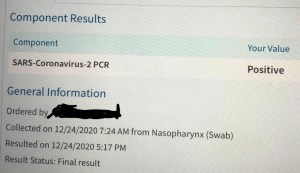 When I received my positive test result on Christmas Eve after being symptomatic. I was quarantined at home, alone, for ten days and stayed home to recover for another seven. I had a mild case and am still dealing with remnants of that impact. Given what I witnessed in the deaths and grief of many, I was blessed with a mild case of this reality.
 This Chaplain's Journey